



Knowing how to sanitize your home after illness is different from regular cleaning, and the difference matters. When someone in a GTA household gets a flu, cold, or stomach bug, a standard wipe-down of surfaces does not stop it from spreading to other family members. You need to know which surfaces transmit illness, what products actually work, and in what order to treat each room. This guide covers the full process based on Public Health Ontario guidelines for residential disinfection.
The distinction between cleaning, sanitizing, and disinfecting is real and practical. Cleaning removes visible dirt. Sanitizing reduces bacteria to a safe level. Disinfecting kills viruses and bacteria on contact. After illness, you need to disinfect, not just clean. Public Health Ontario has guidance on recommended disinfectants through the Public Health Ontario’s surface cleaning and disinfection guidelines.
In this article
This article is also available as a podcast. Hit play to listen while you work or commute. This player is fully compatible with screen readers and assistive technology.
Cleaning vs Sanitizing vs Disinfecting
| Action | What it does | When to use it | Common products |
|---|---|---|---|
| Cleaning | Removes dirt, grease, food residue | Routine maintenance | Soap and water, all-purpose spray |
| Sanitizing | Reduces bacteria by 99.9% | Food prep surfaces, children’s items | Diluted bleach, food-safe sanitizers |
| Disinfecting | Kills viruses and bacteria on contact | After illness, high-touch surfaces | Lysol, bleach solution, EPA-registered disinfectants |
High-Touch Surfaces to Prioritize
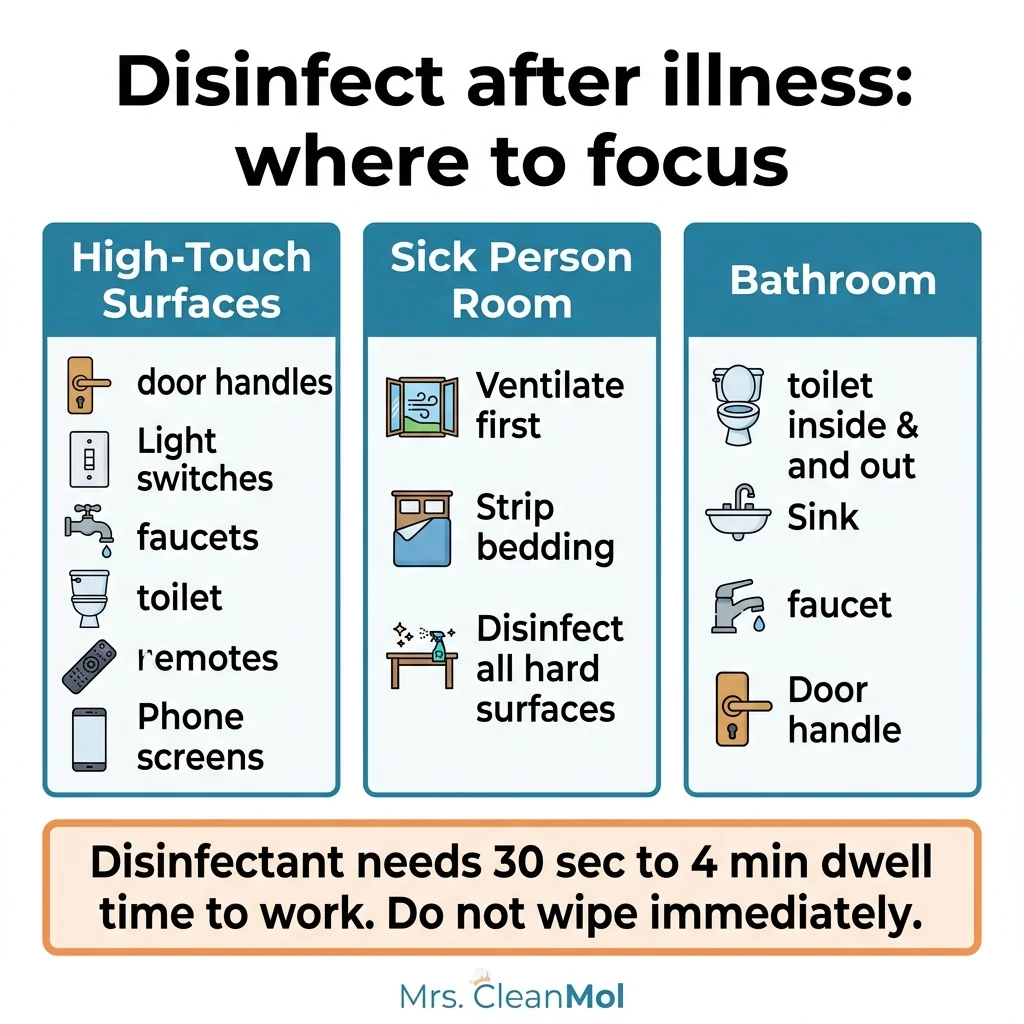
These are the surfaces that transfer illness most effectively between household members. Disinfect these first and most thoroughly:
- Door handles and knobs, especially the bathroom and bedroom doors of the sick person
- Light switches throughout the home
- Faucet handles in bathrooms and kitchen
- Toilet flush handle and toilet seat
- TV remotes and game controllers
- Phone screens and tablets
- Keyboard and mouse
- Refrigerator handle
- Stair bannisters and handrails
PRO TIP
Disinfectant wipes and sprays need dwell time to kill viruses. Most products need the surface to remain visibly wet for at least 30 seconds to four minutes (check the label). Wiping immediately after application does not disinfect, it just moves the product around. Spray, walk away, come back, then wipe.
The Sick Person’s Room
Do not deep clean the sick room while the person is still ill. You will contaminate yourself and spread particles through the home. Wait until the person has recovered, then ventilate the room by opening windows for at least 20 minutes before cleaning.
Strip and wash all bedding at the highest temperature the fabric allows. Wash or disinfect the mattress protector. Wipe all hard surfaces with a Health Canada-registered disinfectant. Dispose of any used tissues or medication packaging. Wash the trash bin with diluted bleach solution.
Cleaning the Bathroom After an Illness
The bathroom requires thorough disinfection after someone with a stomach illness, flu, or cold has used it. Disinfect the toilet bowl, seat, outside of the bowl, and the flush handle. Wipe down the sink faucet, handle, and basin. Clean the door handle on both sides. Replace the hand soap and add a pump of hand sanitizer near the entry.
DID YOU KNOW
Norovirus (stomach flu) can survive on hard surfaces for up to two weeks and on soft surfaces for a shorter but still significant period. Standard all-purpose cleaners do not kill norovirus. You need a product specifically listed as effective against norovirus, such as a bleach-based solution (1,000 ppm chlorine, or about 1 tablespoon of bleach per litre of water).
Kitchen and shared areas
Disinfect the kitchen counter where the sick person prepared food or poured drinks. Wipe the refrigerator handle, cabinet handles in the kitchen, and the kettle or coffee maker handles. Wash any dishes or utensils used by the sick person separately or run a hot dishwasher cycle. Change and wash dish towels and cloths.
PEOPLE OFTEN ASK
When should I disinfect after someone in my home gets sick? Start disinfecting high-touch surfaces as soon as the person shows symptoms, not after they recover. Daily wipes of door handles, light switches, and bathroom fixtures during the illness significantly reduces transmission to other household members. Do the full room disinfection once they have recovered and the room has been ventilated.
For guidance on reducing cross-contamination in your home during and after illness, see our article on how to reduce cross-contamination at home. Our residential cleaning services service includes disinfection in high-touch areas as a standard part of every cleaning service in North York, Toronto, and surrounding communities.
Download the free quick guide
Save this as a PDF and keep it handy.
Frequently Asked Questions
What disinfectant kills flu and cold viruses on surfaces?
Products containing benzalkonium chloride (most Lysol wipes), diluted bleach (1 tablespoon per litre of water), or hydrogen peroxide at 3% concentration are effective against flu and cold viruses. Always check the product label for the specific pathogens it is effective against. Health Canada registers household disinfectants and lists what each kills.
Is it safe to use bleach solution on countertops and kitchen surfaces?
Yes, diluted bleach (about 1 tablespoon per litre of water) is safe for hard non-porous surfaces like countertops when used correctly. Rinse with clean water after disinfection on food-contact surfaces. Do not use on granite, marble, stainless steel, or coloured grout as it can cause discolouration or damage over time.
How long is someone contagious after getting sick?
Most respiratory viruses like the flu and common cold are contagious for about five to seven days after symptoms begin, with the first two to three days being most contagious. For stomach viruses like norovirus, contagiousness begins before symptoms and extends for 48 hours after they resolve. This is why disinfecting during the illness, not just after, matters.
Do I need to sanitize the entire house or just the sick person’s room?
Focus on the sick person’s room, the bathroom they used, and all high-touch surfaces throughout the common areas. You do not need to sanitize every surface in every room. Prioritizing door handles, light switches, faucet handles, and toilet fixtures in the rooms the sick person accessed covers the majority of transmission risk.
Can I use a steam cleaner to disinfect surfaces after illness?
Steam above 70 degrees Celsius kills most pathogens and is a good option for fabrics and soft furnishings that cannot be washed in a machine. It is not a replacement for chemical disinfectants on high-touch hard surfaces because it does not provide the same residual protection. Use steam for mattresses, sofas, and fabric chairs; use registered disinfectants for hard surfaces.